

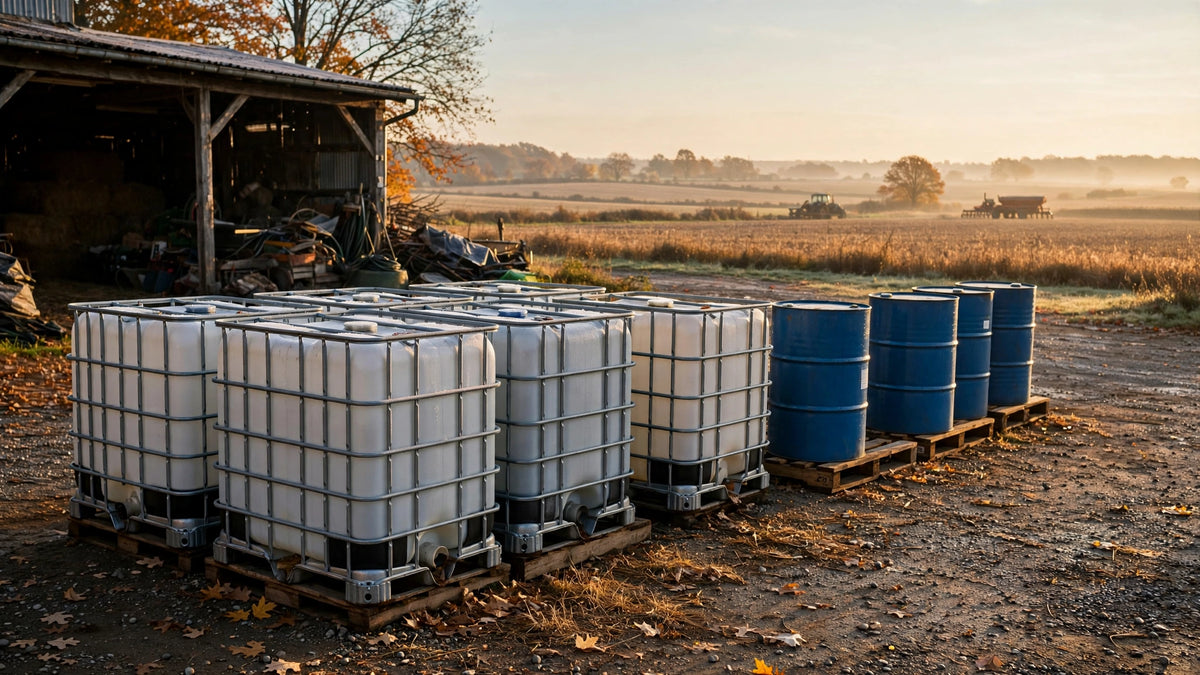
Choose a fertilizer supplier by what the product costs per treated acre, not by the tote price alone. For a bulk liquid order, confirm unloading capacity and label guidance for storage and irrigation use before paying. GS Plant Foods supplies organic and natural fertilizers with free shipping on all products.
Why are commercial operations buying bulk liquid inputs online?
Online ordering lets growers compare package sizes and application rates before requesting a quote. But a listed price per gallon is only the start. A concentrated product may cover more acres than a cheaper liquid, and a bulk discount may not justify buying more than you can store or use.
Dealer pricing versus direct delivery
Buying direct does not automatically mean paying less. Ask for the delivered price and any container charges, then compare equivalent quantities. Check who is responsible for unloading, too. A lower quote is no bargain if you need an unplanned equipment rental to receive it.
Evaluating per-acre input costs
Multiply the label rate per acre by the number of planned applications, then multiply that volume by the delivered price per gallon. For products supplying crop nutrients, compare nutrient quantities as well. A lower application cost does not make two products interchangeable if they serve different roles.
What does receiving a 275-gallon tote or 55-gallon drum actually require?
As a freight-planning rule of thumb, a filled 275-gallon tote weighs roughly 2,500 to 2,800 pounds gross when the liquid weighs 9 to 10 pounds per gallon. Use the shipment's actual gross weight when arranging equipment.
A standard less-than-truckload freight liftgate is often rated around 2,000 to 2,500 pounds. A full tote can exceed that capacity, so confirm the unloading method before booking delivery.
- Confirm the delivery type. Ask whether unloading is driver-assisted or a curbside drop, and where the truck can safely stop.
- Arrange suitable equipment. If there is no dock, arrange a forklift rated for the load or order smaller units the carrier can unload.
- Prepare a level pad. Choose a shaded receiving area away from drainage and water sources. Have a way to move the container into storage.
- Inspect on arrival. Look for leaks or damaged fittings, and record the lot number before putting the shipment away.
Liftgate freight limits versus forklift unloading
Settle unloading before you pay for the tote, not after it is on the truck. Ask the carrier to confirm liftgate capacity in writing. For forklift unloading, check capacity at the required load center and lift height, not just the machine's headline rating.
Staging drums and totes safely on the farm
Place 55-gallon drums on pallets or suitable spill-containment pads. Keep bungs tight and preserve the product labels. Record each lot and receiving date so you can identify the batch if its mixing behavior changes.
How should bulk liquid fertilizers be stored through winter?
Check storage temperatures before choosing a winter delivery date. Freezing can damage some liquid organic products; others may thicken or separate. An unheated barn is suitable only if it stays within the product's labeled storage range.
- Check the label's minimum and maximum storage temperatures.
- Move containers into suitable protected storage before freezing weather arrives.
- Keep containers closed and off wet ground.
- Inspect and remix according to the label before spring use.
Protecting biological liquids from hard freezes
“Biological” does not mean every product contains living organisms, and cold tolerance varies by formulation. If a tote freezes, ask the supplier how to assess it before use. Follow the storage instructions for products such as the Fish and Kelp Fertilizer Organic Liquid Blend; a jar test alone cannot establish whether freezing has damaged a product.
Remixing and agitating separated liquids before field use
Liquids containing suspended solids may settle during storage. Follow the label's mixing instructions before drawing product, and maintain agitation during injection where required. If settled material will not mix back in, ask the supplier before application.
Can organic fish and kelp run through drip and pivot chemigation without clogging?
Some formulations can, but liquid form alone does not establish irrigation compatibility. Fish and kelp products may contain solids that require filtration and agitation. Confirm that the specific product is suitable for your system before injecting it.
An 80 to 100 mesh filter is a common starting range for some drip systems, not a universal specification. Match filtration to the product and emitter requirements. Finer screening may be needed for solids, but a screen that removes the product itself is not a workable solution.
Filter sizing and nozzle protection
Have the irrigation designer or equipment manufacturer confirm filter placement so injected material is addressed before it reaches emitters. A filter upstream of injection will not catch solids introduced afterward. Monitor pressure differences across filters and inspect emitters during the first run.
Running a field jar test before line injection
Use your irrigation water and the planned dilution for a jar test. Look for settling or clumps that suggest incompatibility. Check both labels before combining products; a mixture that looks clear can still be unsuitable for the crop or equipment.
Check the labels for Organic Liquid Fish Fertilizer (NPK 2-3-1) and Organic Liquid Kelp Seaweed for application guidance. Ask the supplier about injection compatibility if the instructions do not address your setup.
Can humic acids and biologicals lower fertilizer costs?
Humic amendments can support nutrient availability and soil structure, but they do not replace the crop nutrients taken out at harvest. Any reduction in purchased nutrients needs support from soil tests and crop requirements, not an assumed savings percentage.
| Input | Primary role | Budgeting limit |
|---|---|---|
| DAP or urea | DAP supplies nitrogen and phosphorus; urea supplies nitrogen | Neither supplies every nutrient a crop needs |
| Humic acid | Supports nutrient availability and soil structure | Does not replace crop-removal nutrients |
| Liquid kelp or fish | Supports plant growth; nutrient content varies by formulation | Must be evaluated by its label analysis and application rate |
Helping crops access soil nutrients
Soil can contain phosphorus that roots cannot readily access. Humic materials may influence nutrient availability, but the response depends on soil conditions and the product. Do not count on a fixed amount of released phosphorus when building the fertility budget.
Integrating biologicals into baseline fertility budgets
Build the baseline from soil test history and realistic crop needs. Give each amendment its own cost-per-acre line, then evaluate its contribution rather than assuming it will pay for itself through fertilizer reductions.
Commercial soybean growers can review our Soybean Farm Program and the role of Organic Liquid Humic Acid within a broader plan. Neither a product choice nor a program page replaces field-specific soil testing.
When should commercial operations pre-book fertilizer to secure pricing?
Plan after soil sampling and before spring demand builds. The American Farm Bureau Federation's April 2026 Fertilizer Availability Survey, with more than 5,700 respondents, found that 67% of Midwest producers had pre-booked fertilizer, compared with 19% in the South. Those figures describe purchasing habits, not proof that early orders always cost less.
Ask whether a quote locks in the price or reserves your supply. Confirm payment terms and delivery timing before committing funds.
The late October to December pre-booking window
For farms finishing harvest in fall, this is a useful planning sequence. Adjust it to your crop calendar and local sampling conditions.
- Late October: Complete post-harvest soil sampling when conditions allow and review field history.
- November: Calculate per-acre costs and request written quotes for the fertility plan.
- December: Confirm order terms, unloading arrangements and suitable storage before booking.
Regional pre-booking benchmarks and cost protection
Farm Bureau attributes the Midwest's higher pre-booking rate to corn-soybean rotations with larger fertilizer needs and earlier purchasing decisions. Your order date should follow your crop calendar, not another region's benchmark. Early delivery only works if you can store the product within its labeled conditions.
Frequently asked questions
How much does a 275-gallon tote of liquid fertilizer weigh, and can a liftgate unload it?
Allow roughly 2,500 to 2,800 pounds gross for a tote containing liquid at 9 to 10 pounds per gallon. Standard freight liftgates often handle around 2,000 to 2,500 pounds, so a full tote may exceed capacity. Confirm the actual shipment weight and carrier rating before delivery.
Can organic liquid fish and kelp fertilizers clog commercial drip irrigation emitters?
Yes, suspended material can clog emitters if the formulation or filtration is unsuitable. Confirm product compatibility with the supplier and match filtration to the irrigation equipment. A jar test helps identify mixing problems but does not guarantee trouble-free injection.
How do biological amendments like humic acid reduce commercial reliance on DAP and urea?
Humic acid may improve access to nutrients already present, but it does not supply a replacement quantity of nitrogen or phosphorus. Reduce primary fertilizer inputs only when soil tests and crop requirements support the change.
When is the best time for commercial farms to place bulk fertilizer orders for spring?
Fall, after soil sampling, is a practical planning window for many spring-planted crops. Late October through December can work where harvest timing allows. Confirm price terms and storage requirements rather than assuming pre-booking guarantees savings.
For a GS Plant Foods bulk inquiry, send your acreage, crop and intended application method through our contact page. Soybean growers can also review our Soybean Farm Program before requesting commercial sizing.

Share:
Poinsettia Fertilizer: When to Feed and When to Hold Off