

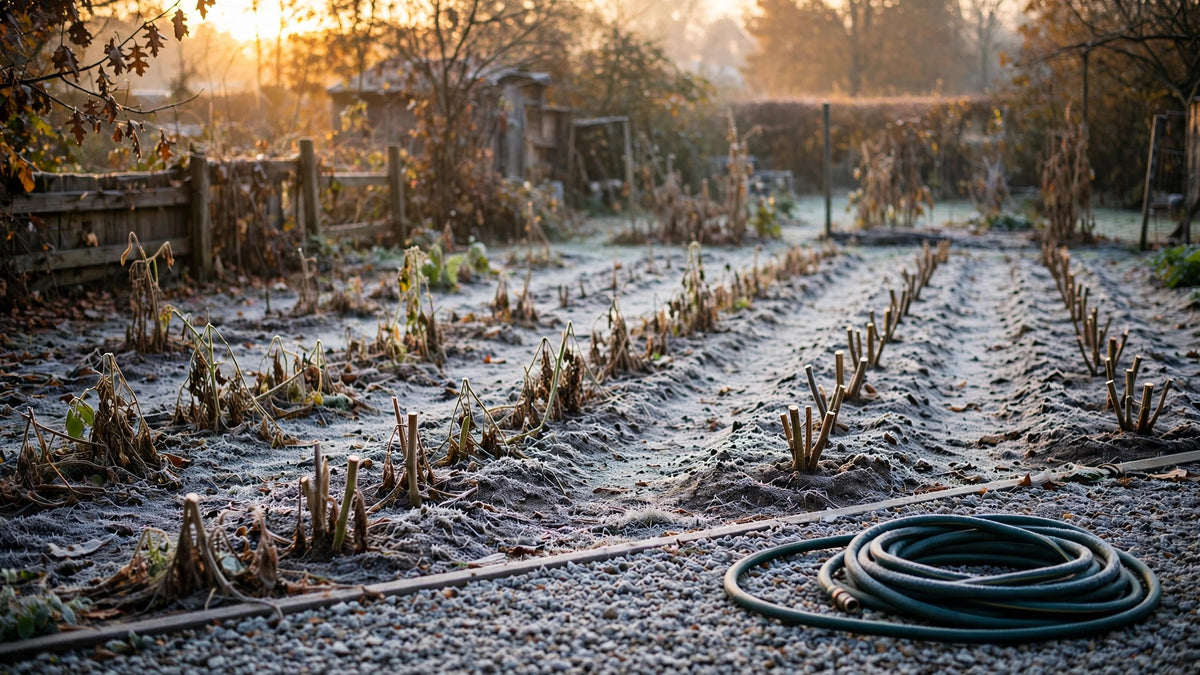
Finished organic compost improves garden soil by adding bulk organic matter and helping it hold water and nutrients. Choose bagged or bulk compost when a bed needs structure. Liquid compost serves a different role: it supports root-zone biology but cannot replace the volume of organic matter that solid compost supplies.
Before buying either, check what the bed needs. Soil short on organic matter needs bulk material, and the Royal Horticultural Society advises gardeners to aim for 3–6% organic matter in managed soil. Most cultivated soils fall below that. A bed that already has plenty of compost may benefit from a liquid soil amendment, but more product is not automatically better.
Can liquid compost replace bagged or bulk compost?
No. A liquid cannot supply the bulk organic matter that changes a bed’s structure. Solid compost helps sandy soil retain moisture and improves the structure of heavier soil. A liquid amendment works with the soil and organic material already there.
Asking a spray to do a wheelbarrow’s job leaves the main problem unresolved. If the bed dries out quickly or has little organic matter, prioritize finished compost. Use a soil test to guide fertility decisions rather than choosing by the product label alone.
What hot composting means for living biology
University of Maryland Extension puts active hot compost piles at 130–170°F.
Properly managed heat reduces viable weed seeds and many pathogens, but it also reduces organisms that cannot tolerate those temperatures.
That does not make finished compost lifeless. Microbial populations change as compost cools and matures. Buy solid compost primarily for its organic matter and structure, rather than assuming it contains particular beneficial organisms. If you want a specific biological function from a liquid product, check what its label actually promises.
Does bagged or bulk compost bring weed seeds and pathogens?
Finished compost from a properly managed hot pile is less likely to carry viable weed seeds, but heat is not a guarantee. Ask how the compost was processed and tested. The U.S. Composting Council’s Seal of Testing Assurance identifies a compost testing program; OMRI Listing addresses suitability for organic production.
Neither an “organic” label nor a dark appearance proves that compost is weed-free or free of herbicide residue. Ask for recent test results and maturity information before spreading a large load.
Weed seed and herbicide residue
Municipal and yard-waste compost can offer good value, but ask whether the source checks for persistent herbicides. Some weedkillers can survive composting and damage crops such as tomatoes and beans. If the source cannot answer, test a small sample with sensitive plants before using it across a vegetable bed.
Manure and salad beds
Keep fresh or partly rotted manure off beds growing crops you will eat raw. Unfinished material calls for reduced application rates, not the same treatment as mature compost. Fresh manure can also introduce weed seeds and strong odors; properly finished compost is the better choice for salad beds.
Bagged, bulk and liquid compared on labor and cost
Compare bagged and bulk compost by delivered cost per cubic foot or cubic yard, including delivery charges. Bulk usually costs less per volume, but bags may make sense for a small bed or a yard without delivery access. Compare liquids by their label coverage, not by bottle size, and remember that they perform a different job.
| Factor | Bagged compost | Bulk compost | Liquid compost |
|---|---|---|---|
| Labor to apply | Carry bags and spread material | Move and spread loose material | Dilute and apply as directed |
| Cost basis | Price per cubic foot | Delivered price per cubic yard or ton | Cost per treated area at the label rate |
| Bulk organic matter added | Yes | Yes | Not enough to replace solid compost |
| Biological role | Supports soil organisms as organic matter breaks down | Supports soil organisms as organic matter breaks down | Depends on the formulation and label claims |
| Quality checks | Ask for maturity and testing information | Ask about maturity and herbicide testing | Check ingredients and application directions |
| Timing | Fall or spring, according to the bed’s needs | Fall or spring, including surface applications | During suitable growing conditions; biology slows in cold soil |
What does liquid compost do in an untilled bed?
A soil-applied liquid needs to reach the soil rather than remain on dry surface residue. Apply evenly, then use light watering if the label directs it. You do not need to dig simply to incorporate a liquid amendment.
Humic and fulvic acids can help with nutrient availability in the root zone, but they do not replace bulk organic matter. Our Root Ruckus Liquid Compost is formulated to stimulate mycorrhizae and support root expansion. Treat that as root-zone support, not a way to build a deep layer of soil.
For those distinct roles, see our organic liquid humic acid soil conditioner and Root Ruckus Liquid Compost.
Does cold weather change a late-fall liquid application?
Soil microorganisms break down organic matter quickly in warm conditions and much more slowly in winter. A late-fall application therefore depends on the weather, not the calendar alone. Late October can offer workable conditions in one part of the United States and frozen ground in another.
Choose a mild spell with several above-freezing days ahead, well before a hard frost. Keep the bed moist rather than saturated. If the ground is already frozen, postpone the application instead of expecting a liquid to restart biological activity.
How do you spray liquid compost on spent beds before the freeze?
Start with cleanup, then follow the product’s dilution and application directions. A liquid amendment cannot neutralize weed seeds or make diseased crop residue safe to leave in place.
- Remove seed-headed weeds and diseased residue. Pull or bag weeds that have gone to seed. Remove affected crop material rather than relying on a spray to break it down safely in the bed.
- Check drainage and compaction. Look for standing water and resistance to a garden fork. A soil test can guide nutrient and organic-matter decisions, but it does not diagnose every drainage problem.
- Check soil moisture. If the surface is very dry, lightly moisten it before treatment where the label permits. Avoid applying to saturated ground.
- Apply evenly at the label rate. A hose-end sprayer can help distribute a compatible liquid product. Confirm the sprayer setting rather than guessing at the dilution.
- Water in only as directed. Light watering can move a soil-applied liquid through surface residue. Avoid heavy watering that sends it running off the bed.
If water continues to pool after ordinary rainfall, address the drainage problem before adding more liquid. A wetting agent cannot replace physical correction where soil is severely compacted.
How do you pair a mulch layer with liquid compost?
Keep the two jobs separate. A surface layer of finished compost adds organic matter; a liquid amendment supports the function stated on its label. Oregon State University Extension describes sheet mulching and lasagna composting with cardboard as no-dig methods for suppressing weeds and enriching beds.
Do not count on a fall spray to leave a fully decomposed, planting-ready bed by spring. Temperature and the type of residue determine how quickly breakdown happens. Add bulk compost when the bed needs it, and use a liquid only for a defined supporting role. Application timing should follow your local conditions.
If your bed already has adequate organic matter and you want root-zone support, review the application directions for Root Ruckus Liquid Compost before ordering.
Frequently asked questions
How much compost do I need per square foot of garden bed?
The amount depends on your soil and the depth you intend to apply. Calculate the volume by multiplying bed area by application depth, using the same units throughout. The Royal Horticultural Society gives a bulk rate of 5–10 kg per square metre for organic matter. Compare that volume with the supplier’s coverage information, and use soil-test results to avoid unnecessary additions.
Does hot composting kill mycorrhizae and beneficial bacteria?
Hot compost piles can reach 130–170°F, which reduces many heat-sensitive organisms. Finished compost is not necessarily sterile, because microbial populations change as it cools. Do not assume purchased compost contains particular mycorrhizal fungi unless the supplier documents them.
Can you put compost on top of soil without tilling it in?
Yes. Finished compost can be applied as a surface layer without tilling, and Oregon State University Extension describes no-dig approaches such as sheet mulching. Soil organisms gradually incorporate solid material; watering does not wash an entire compost layer into the soil.
How do you know if purchased compost is mature and safe to use?
Mature compost is generally dark and crumbly, with an earthy smell rather than a strong sour or ammonia odor. Ask the supplier for maturity and safety testing, including information about herbicide residues. The U.S. Composting Council’s Seal of Testing Assurance identifies testing participation, while OMRI Listing addresses organic-production suitability; neither replaces checking that the material fits your intended use.
Share:
Peony Fertilizer: What Bare Roots Need at Fall Planting
Potato Leaves Turning Yellow: How to Tell Maturity From Stress