

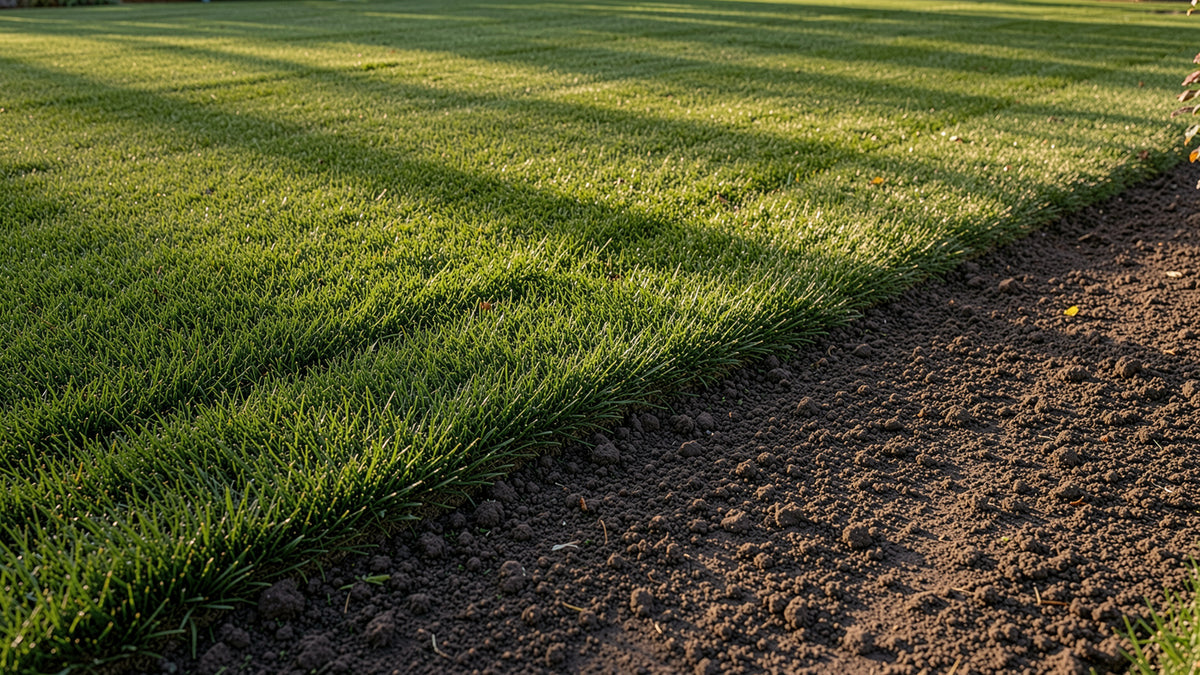
Liquid soil aeration uses agricultural wetting agents and humic carbon to lower water surface tension and flocculate dense clay platelets, treating 100 percent of your lawn without risking buried utilities. While mechanical core aerators pull mud plugs across roughly 10 percent of the surface, liquid conditioners travel with moisture past the top three inches to build open, season-long drainage.
Choosing between spraying and pulling plugs comes down to the depth of your compaction. If you are dealing with chronic compaction from heavy foot traffic or stubborn subsoil in a newer neighborhood, here is what really happens beneath your turf when you use each method.
How Soil Compaction Develops and How to Test Turf Depth
Soil compaction happens when steady downward pressure squeezes microscopic pore space out of your dirt. Over late spring and summer, backyard foot traffic forces soil particles tightly together. In clay-heavy soils, these particles are shaped like flat microscopic plates. As moisture evaporates during hot weather, those plates settle flush against one another like wet sheets of paper, leaving nowhere for roots to grow.
By October, cool-season turf grasses shift their energy toward root expansion before winter dormancy. If your soil profile stays dense and tight, autumn rains sit on the surface instead of recharging the lower root zone. The roots remain shallow, leaving the lawn exposed to winter frost heaving.
The Screwdriver Test for Clay Hardpan
Before renting machinery or buying treatments, grab a standard six-inch metal screwdriver and walk your lawn a day after soaking rain. Push the screwdriver into the turf using only firm palm pressure.
If the screwdriver stops dead at two inches, you are fighting severe surface compaction, often worsened by thatch crusting. If the tool slides smoothly through the top three inches but hits a brick wall at four inches, you have deep hardpan. Mechanical core aerators with two-to-three-inch hollow tines cannot reach a four-inch hardpan layer. Knowing where that dense resistance sits tells you which tool will actually solve your drainage problem.
Why Autumn Compaction Threatens Winter Root Survival
A compacted lawn entering winter creates an oxygen-starved root system. When dirt lacks pore space, water saturates the upper inch and cannot percolate downward. Freezing winter temperatures turn that standing water into a solid sheet of ice that suffocates grass crowns. Opening the soil profile in early autumn lets late-season root fertilizers and moisture move deep into the subsoil, helping turf wake up thicker and greener in spring.
Liquid Soil Aeration Compared to Mechanical Core Aeration
The difference between these approaches comes down to physical removal versus biological and chemical conditioning. Mechanical coring relies on heavy steel tines to pull dirt plugs out of your turf. Liquid aeration uses a hose-end blend of surfactants and humic acids to break the surface tension of water entering the soil, loosening the colloidal bonds that lock clay particles together.
Core Aeration vs Liquid Aeration Breakdown
| Evaluation Metric | Mechanical Core Aeration | Liquid Soil Aeration |
|---|---|---|
| Lawn Surface Coverage | Roughly 10% of total surface area | 100% continuous surface coverage |
| Effective Working Depth | 2.0 to 3.0 inches (limited by tine length) | 4.0 to 12.0 inches (travels with water) |
| Time to Visible Results | Immediate physical holes and surface plugs | Gradual; 2 to 8 weeks through water cycles |
| Property and Utility Hazard | High risk to sprinkler heads, wires, and pipes | Zero risk to underground utilities |
| Physical Labor Required | Heavy (loading/hauling 200+ lb machine) | Minimal (standard hose-end spraying) |
| Soil Biology Impact | Physical venting; can expose weed seeds | Feeds microbes and adds organic carbon |
| Overseeding Window | Immediate (seed drops into pulled holes) | Immediate (seed benefits from moisture retention) |
Evaluating Immediate Relief Against Progressive Conditioning
Mechanical coring gives you immediate physical venting. As hollow tines pull dirt cores out of the ground, air enters those specific openings right away. However, an analysis by lawn care platform LawnLove (2025) shows that mechanical aerators physically disturb only about 10 percent of the lawn surface area during a normal pass. The remaining 90 percent of your soil remains just as dense and compacted as before.
Liquid conditioners like Soft Soil Liquid Soil Aerator do not pull mud plugs, and anyone claiming they leave physical holes is misleading you. Instead, liquid treatments blanket the entire lawn. As moisture cycles through the dirt over two to eight weeks, the active components seep downward, creating thousands of microscopic fractures throughout the entire root zone rather than leaving isolated holes every few inches.
The Physical Realities and Property Hazards of Core Aeration
Running a mechanical core aerator is backbreaking labor. These machines typically weigh between 200 and 280 pounds to force hollow steel tines into heavy ground. Hauling one requires ramps and a truck to haul the machine home. Maneuvering that heavy frame across tight side yards, up terraced slopes, or through narrow garden gates frequently damages turf edges and landscape beds.
For homeowners who want physical aeration on small, flat patches of grass without wrestling a gas engine, a rolling manual push lawn aerator offers an easy way to vent high-traffic paths and walkway edges.
Depth Limits of Hollow Steel Tines
The mechanical limit of a core aerator tine is usually two to three inches. In dry, sun-baked clay, those tines often bounce and penetrate barely an inch, merely scratching the turf crust. If your screwdriver test revealed a hardpan layer four inches down, a core aerator cannot reach it. The machine rolls right over the true barrier, dropping messy plugs across your lawn without improving deep subsoil drainage.
Puncture Hazards for Irrigation and Buried Utilities
The biggest risk with mechanical aeration is utility damage. In residential yards, modern conveniences sit directly beneath the grass:
Mechanical tines regularly puncture shallow irrigation lines buried only three to six inches deep, crack hidden sprinkler bodies, sever subsurface drip tubing, and slice invisible dog fence boundary wires running one to two inches beneath the thatch.
Marking every sprinkler head with utility flags takes hours. Missing one buried line means an expensive weekend repair. Liquid aerators remove this hazard entirely, treating dense soil around delicate sprinkler assemblies without physical impact.
How Liquid Aerators Break Colloidal Clay Bonds Without Machinery
Dismissing liquid soil aerators as snake oil ignores colloidal soil chemistry. Clay particles are microscopic colloids carrying strong negative electrical charges. These charges attract water molecules in a way that builds extreme surface tension. When soil dries out, electrostatic forces pull these flat clay platelets together, sealing off pore space like plastic wrap.
The Science of Colloidal Flocculation
Liquid soil aerators use agricultural surfactants like ammonium laureth sulfate to lower the surface tension of water. Breaking this tension lets moisture slip into the microscopic spaces between hydrophobic clay particles rather than beading up or running off into the street.
Once water enters those tight gaps, active humic fractions bond to the clay platelets. Humic compounds break the electrostatic attraction, causing individual clay plates to clump into tiny granules in a process called flocculation. This opens microscopic channels for air and roots. Pairing a wetting agent with an organic liquid humic acid conditions the soil structure and provides organic carbon that feeds native soil microbes, which then maintain that open soil profile naturally.
Why Household Dish Soap Is Not a Real Liquid Aerator
Spraying kitchen dish soap to aerate soil on the cheap is a mistake. While dish soap is technically a surfactant, it contains harsh degreasers designed to strip grease from pans. Applying dish soap strips the natural waxy coating from grass blades, desiccates root crowns, and damages delicate soil microbes. True agricultural aerators use gentle wetting agents and natural bio-stimulants that loosen dense clay without burning your grass.
How to Apply Liquid Aerator for Deep Autumn Infiltration
Liquid aerator applications are simple and fit right into an October lawn care afternoon. To get the best results on dense clay, proper application rates and prompt watering are essential.
- Mow the lawn: Cut your turf to its normal autumn height of roughly two and a half to three inches, then rake off heavy leaf piles so your spray hits the dirt.
- Check soil moisture: Never apply liquid aerator to bone-dry, cracked dirt. Lightly water the lawn the evening before so the soil profile is receptive.
- Set up your sprayer: Attach an applicator like the Bonide Auto Mix hose-end sprayer to your garden hose, setting the dial to the rate specified on your product label.
- Spray in a cross-hatch pattern: Walk at an even pace, sweeping the spray wand smoothly to ensure uniform coverage across the entire lawn.
- Run the water immediately: As noted in an aeration guide from home services platform Angi (2023), post-application watering is mandatory. Water the treated lawn thoroughly with at least a half-inch of water right after spraying to wash the active surfactants and humic conditioners down past the grass blades and into the root zone. Setting an automated programmable sprinkler timer ensures your lawn gets a thorough soak the moment you put the sprayer away.
Coordinating Fall Overseeding and Feeding
Liquid conditioning will not interfere with your fall overseeding plans. You can broadcast grass seed right after spraying an organic liquid soil aerator. The conditioning agents reduce surface crusting and improve seed-to-soil moisture transfer, keeping fresh seed hydrated during germination.
If you are applying late-season fertilizers, spraying your liquid aerator first allows those nutrients to migrate past the thatch line rather than washing away with autumn surface runoff.
Which Soil Aeration Method Should You Choose for Your Yard
Every lawn is different, and neither method fits every situation. Choosing the right one depends on your lawn layout and how deep the compaction runs.
Choose Liquid Soil Aeration if:
- Your lawn features shallow underground sprinkler pipes, drip zones, invisible dog fencing, or landscape lighting wiring that mechanical tines could cut.
- Your yard has steep slopes, retaining walls, or narrow gates that prevent safely running a 200-pound gas machine.
- Your screwdriver test revealed hardpan sitting four to six inches below the surface, beyond the reach of standard mechanical tines.
- You want 100 percent continuous surface coverage rather than treating only 10 percent of the yard.
- You prefer a simple hose-end spray without truck rentals, heavy lifting, or messy mud plugs littering the lawn.
Choose Mechanical Core Aeration or a Hybrid Approach if:
- You are dealing with severely crushed subsoil on a new home build where skid steers packed the dirt into solid stone.
- You have heavy surface thatch exceeding one-half inch that requires physical disruption to allow water passage.
- You need instant drainage relief for standing puddles ahead of an immediate turf event or sod installation.
In severe compaction scenarios, combining both techniques works well. Run a mechanical pass to fracture the surface crust, then follow up with liquid humic conditioning to send organic carbon deep into the subsoil fractures. If you are building out a complete seasonal turf care plan tailored to your grass type and regional climate, review our step-by-step Custom Lawn Program for targeted guidance.
To soften stubborn clay, open deep root channels, and protect your irrigation lines this autumn, treat your yard with Soft Soil Liquid Soil Aerator, backed by free shipping across the United States.
Frequently Asked Questions
Do you have to water your lawn immediately after applying a liquid aerator?
Yes, thorough immediate watering is required after application. Liquid aerators work in the soil profile, not on the foliage. Giving the yard a half-inch of water right after spraying washes the active surfactants and humic conditioners off the grass blades and pushes them deep into the root zone where compaction lives.
How long does it take for a liquid aerator to work?
Liquid aeration works through repeated moisture cycles rather than pulling instant plugs, typically showing visible improvements in water infiltration and soil softness within two to eight weeks. As rainfall and irrigation move through the treated soil, the surfactants and humates continue to open microscopic channels between the clay particles.
Can you spread grass seed immediately after spraying a liquid soil aerator?
Yes, organic liquid aerators do not harm seed germination, allowing you to broadcast seed right after application. The humic compounds and wetting agents actually help newly sown grass seed by improving moisture retention in the top layer of dirt, provided you keep the seedbed damp.
How many applications of liquid aerator are needed to soften hard turf?
Most clay lawns benefit from one to two applications per year, applied during peak root development windows in early autumn or mid-spring. Severely compacted soils or yards recovering from heavy construction traffic may require two applications spaced four weeks apart during their first season of recovery.
Can liquid soil aerator completely replace renting a heavy mechanical core aerator?
For established turf with underground irrigation, steep grades, or hardpan deeper than three inches, liquid aerator is a complete replacement that saves your back and protects buried wires. However, severely compacted new construction subsoils that have been crushed by heavy grading equipment often benefit from an initial hybrid approach that uses mechanical coring followed by liquid humic treatments.
Share:
Bulb Fertilizer: What to Feed Spring Bulbs at Fall Planting
Organic Fish Fertilizer: Application Rates and Odor Guide