

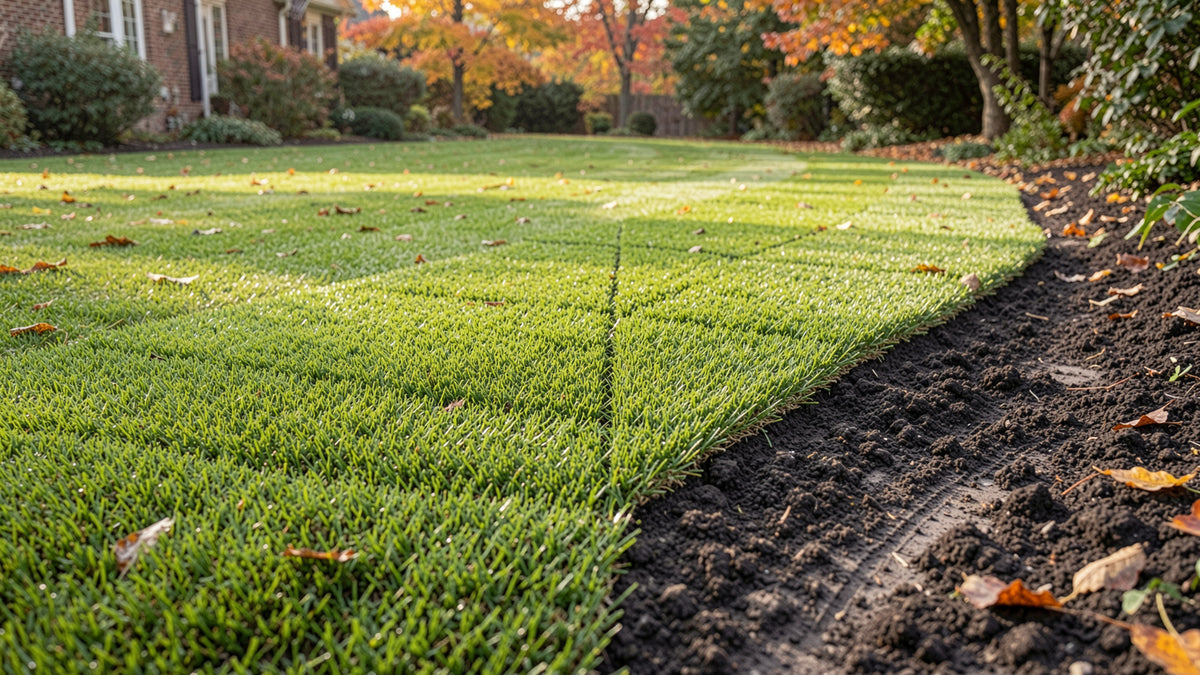
The best new sod starter fertilizer is not a high-analysis synthetic granule. Fresh sod arrives with up to ninety percent of its root plate sliced away at the farm. Dumping harsh chemical starter fertilizer loaded with synthetic salts creates an osmotic draw that pulls water backward out of vulnerable root nubs, scorching cut edges before they can knit into your subsoil. Gentle liquid compost and humic amendments work differently by delivering readily bioavailable organic carbon straight to the root seam without salt stress.
According to turfgrass establishment research documented by Wikipedia's review of sod cultivation, commercially grown sod takes ten to eighteen months to mature before field harvesters sever its root plate. Dumping high-analysis synthetic salts directly onto those sheared root edges forces moisture out of the plant cells rather than feeding them. Safe autumn establishment requires conditioning the parent dirt, introducing non-burning biological nutrients across the sod-to-soil boundary, and maintaining a strict moisture gradient that coaxes roots downward before the ground freezes.
Prepare the Subsoil and Apply Liquid Aeration on Day One
A new sod installation or fall overseeding project succeeds or fails at the seam where the sod pad meets your yard's native dirt. Laying fragile root systems directly over hard ground prevents root hairs from penetrating down into moisture reserves. Breaking up surface tension before or during installation establishes microscopic pathways in tight subsoil.
- Clear stones and dead weeds from the grading site to provide a clean, smooth subsoil base.
- Grade the parent dirt so water drains away from home foundations, leaving the soil surface roughly one inch below surrounding walkways and patios.
- Attach a bottle of Soft Soil liquid soil aerator to your garden hose and spray the bare grade thoroughly to open tight clay particles.
- Lay your sod rolls or broadcast cool-season turf seed across the treated ground immediately, rolling the surface gently to ensure full contact between root pads and dirt.
The common mistake at this stage is renting a heavy mechanical core aerator that churns up dormant weed seeds, leaves unsightly soil cores, and creates an uneven base beneath fresh sod slabs. Conditioning the dirt with an organic liquid wetting agent loosens compacted soil without tearing up the yard or shifting your grade.
Why Subsoil Compaction Halts Root Penetration
When subsoil is packed tight by foot traffic, construction equipment, or heavy summer sun, soil particles press together so tightly that pore space vanishes. Fresh sod roots cannot muscle their way through dense clay. Denied entry into the lower dirt, root tips curl horizontally along the bottom of the sod mat, creating a shallow, detached layer of turf that wilts the first time dry autumn winds sweep through. Liquid conditioning agents break the surface tension of compacted particles, allowing moisture and fragile root hairs to slip deep into the subsoil profile.
Can You Spread Grass Seed Immediately After Applying Liquid Aerator
You can spread grass seed or roll out sod rolls immediately after spraying. Unlike mechanical aerator tines that disturb graded earth and pull up buried weed seeds, a liquid conditioner works chemically through gentle biological wetting agents. We cover the mechanical differences in detail in our comparison of liquid soil aeration versus core aeration. Because the liquid formulation does not physically disrupt the topsoil, you can spray your dirt, broadcast your seed, and rake it in during the exact same afternoon without damaging seed distribution or burning delicate embryos.
Why High Salt Synthetic Fertilizers Scorch Fresh Sod Roots
Many traditional lawn programs instruct homeowners to spread high-analysis granular starter fertilizers like 18-24-12 or 20-27-5 directly onto bare dirt before laying sod, or immediately across the grass blades. These recommendations overlook the physiological trauma that sod undergoes during harvesting and transport.
| Factor | Synthetic Starter Granules (18-24-12) | Liquid Biological Starters (Compost and Kelp) |
|---|---|---|
| Salt Index | High (draws water out of plant root tissue) | Near zero (no chemical salt stress) |
| Root Contact Safety | High risk of osmotic cell burn on fresh cuts | Completely safe for direct application on severed nubs |
| Plant Response | Forces fast, watery leaf growth | Drives downward adventitious root expansion |
| Soil Biology Impact | Can suppress native beneficial soil fungi | Feeds mycorrhizae and soil microorganisms |
The mistake at this phase is chasing rapid cosmetic greening. Forcing quick leaf growth with synthetic salts during mid-October drains stored carbohydrates that cool-season grasses need to anchor into the dirt before winter dormancy arrives.
The Osmotic Shock of Granular Starter Fertilizers
Turfgrass extension guidelines documented in a guide from LawnStarter's starter fertilizer analysis explain that synthetic fertilizer salts increase the salinity of the surrounding soil water solution. When the concentration of mineral salts in the soil exceeds the salt concentration inside the grass cells, osmosis reverses direction. Instead of roots taking up moisture, water gets pulled out of the plant cells and back into the ground.
On an established lawn, mature roots can often tolerate this chemical pull if watered in heavily. On newly installed sod, where cut root endings are open wounds, this osmotic shock desiccates cell walls, leaving yellow patches across the lawn and stalling root regeneration entirely.
Why Your Fresh Sod Rolls Are Already Pre-Fertilized
Commercial sod farms manage turf carefully for over a year to make sure pallets look dense and green when they arrive at your curb. Professional sod growers typically apply standard fertility treatments just weeks prior to cutting. As practical management guidance from a Florida sod producer's guide at Bayside Sod's establishment guide notes, newly laid turf already contains enough stored nutrients within its crown and foliage to support early survival. Dumping another dose of chemical nitrogen on day one overwhelms the severed roots. Rather than adding synthetic chemicals, you should apply biological inputs like Root Ruckus liquid compost, which supplies organic humic fractions and bioavailable carbon without salt stress.
Apply Liquid Compost and Biostimulants for Fast Root Knitting
Instead of forcing leaf blade extension, your primary goal during the initial twenty-one days is establishing deep root anchors. Liquid biostimulants, humic acids, and kelp extracts deliver bioavailable trace elements directly to the root seam, activating soil biology and accelerating cell division at cut root ends.
- Measure your new sod or seeded lawn area to determine the proper liquid concentrate volume, typically working at a rate of 4 to 8 ounces of liquid bio-blend per 1,000 square feet.
- Fill a dedicated hose-end applicator, such as the Bonide auto-mix hose-end sprayer, setting the dial to match your desired dilution rate.
- Walk slowly across the fresh turf, spraying an even sweep over the foliage so the liquid carrier washes the nutrients down between the seams and into the subsoil.
- Follow the application with a brief water-in cycle to ensure the liquid carbon and kelp coat the adventitious root nubs resting against the parent dirt.
The major mistake during this stage is waiting several weeks before feeding. Severed root nubs need immediate biological signals to knit into native soil. Delaying organic feeding leaves roots idling in the sod thatch layer without initiating downward growth.
Delivering Nutrients Directly to the Adventitious Root Seam
Unlike dry fertilizer granules that sit on top of the grass canopy until dissolved by heavy water, liquid biological solutions wash down to the contact line between sod mat and dirt. Incorporating organic liquid humic acid into your spray tank conditions both the sod backing and your yard's subsoil. Humic fractions act as natural chelators, binding to native soil minerals and unlocking bound phosphorus so new roots can absorb it naturally without salt accumulation.
Hose-End Sprayer Setup and Application Rate
Using a hose-end sprayer eliminates heavy machinery and spreader wheels that can buckle, shift, or roll back freshly laid sod slabs. Pour your concentrated liquid compost and kelp mix into the sprayer jar without diluting it in the container. Set the metering head to 4 ounces per gallon, attach your garden hose, and spray evenly from edge to edge. The continuous flow of water serves as the carrier, delivering the biological humates straight past the grass canopy and deep into the root zone.
Establish a Two Week Watering Routine to Drive Deep Anchors
Water management makes or breaks fall turf establishment. Severed root systems dry out quickly because they cannot pull moisture from deep below the surface. At the same time, saturating the dirt until it turns into a swamp cuts off soil oxygen and suffocates young root hairs.
- Days 1 to 3: Water two to three times daily for 15 to 20 minutes per zone to keep the sod mat and top inch of native dirt steadily damp.
- Days 4 to 7: Reduce watering frequency to two cycles daily, running sprinklers long enough to push moisture two inches into the dirt.
- Days 8 to 14: Transition to a single morning watering session every day, putting down roughly one-quarter inch of water to encourage downward root search.
- Days 15 to 21: Taper watering to every other day, soaking the soil down three to four inches to build deep root reserves before winter frosts arrive.
The mistake homeowners make here is watering lightly every evening. Late-day watering leaves leaf surfaces wet overnight, inviting fungal issues like brown patch, while failing to penetrate into the dirt beneath the sod mat.
Moisture Depth Versus Anaerobic Mud Swamps
Check moisture levels daily during the first week by lifting the corner of a sod roll in two or three spots. You want the underside of the sod backing moist and the native dirt beneath it visibly damp. If the ground underneath feels like squishy mud or smells sour, you are overwatering. Stagnant puddles push oxygen out of soil pore spaces, creating an anaerobic environment where delicate roots rot. Applying organic liquid kelp seaweed during this early hydration window delivers natural trace minerals that help turf manage moisture fluctuations and environmental stress.
Day by Day Watering Schedule Through Week Two
Morning irrigation between 6:00 AM and 10:00 AM is ideal. Early watering lets moisture soak deep into the dirt while autumn sun and wind dry the grass blades during the day. By the start of week two, dial back your frequency while extending runtime slightly. Forcing the top half-inch of dirt to dry out slightly between waterings prompts the grass to stretch its new roots deeper in search of moisture.
Perform the Tug Test Before Your First Autumn Mow
Newly laid sod usually establishes working root systems within thirty days when properly hydrated and biologically fed. However, running a heavy rotary mower across the lawn before roots have gripped the dirt can shear off young root hairs, pull up sod edges, and ruin weeks of work.
Before wheeling your mower onto the lawn, perform the tug test. Grab a handful of grass blades at the center of several sod slabs and pull straight up with gentle pressure. If the sod roll lifts like a loose rug, roots have not anchored yet. Wait. Check again in five to seven days. Once the turf holds firm against your pull, the root knitting process is underway, and the lawn can safely support foot traffic and mower wheels.
When you are ready to cut, make sure your mower blade is razor-sharp. Dull mower blades do not cut cleanly; they shred and rip grass blades, yanking on newly anchored roots underneath. Never remove more than one-third of the total blade height during a single mowing session. If you let the grass grow to four inches, cut it down to around three inches. Keeping adequate leaf surface intact allows the plant to continue photosynthesizing, manufacturing food to fuel root growth before winter sets in.
For broader seasonal lawn care programs and cold-weather turf preparation, explore our custom lawn feeding plans and our practical guide to autumn winterizer fertilizers to protect your yard through the winter months.
Frequently Asked Questions
Can I spread grass seed immediately after applying liquid soil aerator?
Yes, you can spread grass seed or install new sod rolls the exact same day you apply a liquid soil aerator. Liquid aerators work by using gentle conditioning agents to loosen compacted soil particles without physically turning over dirt or disrupting your grade. Because there are no mechanical tines to disturb the soil bed, grass seed can be scattered immediately without risking uneven germination or root injury.
Why did my new sod turn yellow after applying starter fertilizer?
New sod turns yellow when high-salt chemical starter fertilizers cause osmotic root burn on severed root tips. Commercial turf is already fertilized at the sod farm prior to harvest, meaning shallow roots cannot assimilate excess concentrated chemical salts. This salt overload pulls moisture backward out of the grass cells, scorching tender root tissues and leaving yellow patches across your lawn.
How soon should you apply starter fertilizer to new sod?
Gentle organic liquid compost, humic acids, and kelp biostimulants should be applied on day one to accelerate subsoil root knitting without salt stress. Traditional high-nitrogen synthetic starter granules, by contrast, should be avoided for the first four to eight weeks following installation. Delaying harsh chemicals lets the turf establish a functional root system before absorbing strong nutrient loads.
How do you know when new sod roots have anchored into the subsoil?
You can confirm root establishment by performing a gentle tug test at weeks two and three. Grab a small handful of grass blades in several spots across your yard and pull upward with light, steady pressure. If the sod resists your lift and stays anchored to the dirt, the adventitious roots have successfully knitted into the subsoil.
Share:
Bulb Fertilizer: What to Feed Spring Bulbs at Fall Planting
Organic Fish Fertilizer: Application Rates and Odor Guide